
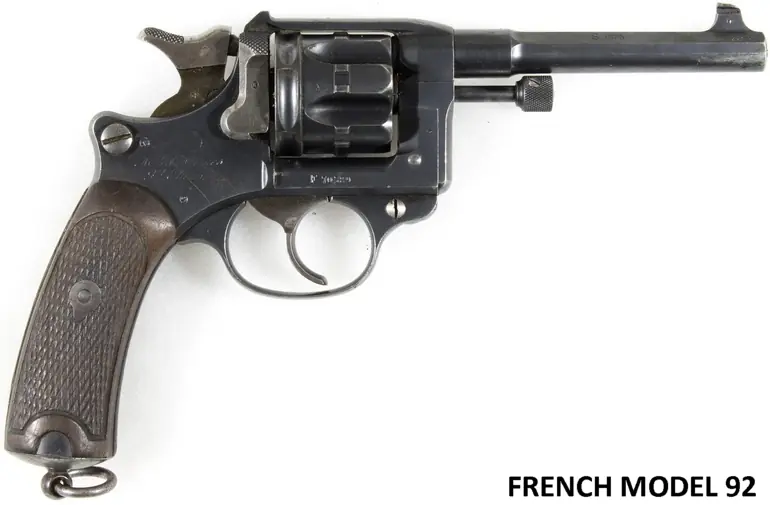
By the time hostilities ceased in the Franco – Prussian War of 1870, the French realised that they needed a serious and urgent modernisation of their military capabilities. The handgun that they adopted at that stage was the 11mm Mle. 73 Chamelot-Delvigne. During the mid-1880’s the French were again researching to modernise their military when French chemist Paul Marie Eugène Vieille came up with a revolutionary invention that changed the face of modern warfare forever. It was called Poudre-B or nitrocellulose based smokeless gunpowder. This game changing technology led to the development of the Lebel M1886 Rifle; the first rifle adopted by any military power utilising this new powder. The French were at that time looking at the Galand-Schmidt swing-out cylinder design revolver and utilised it to develop the Mle. 92, which became the standard side-arm of the French. Interesting about the Mle. 92 was that cylinder opens to the right and not the left, favouring cavalry officers using a sabre with the right hand and the revolver with the left. the Mle. 92 was the standard side-arm of the French, until WW 1 and intermittently afterwards, until final production ceased in 1948. It is sometimes called the 8mm Lebel revolver, however there is no evidence that Colonel Nicolas Lebel (18 August 1838 – 6 May 1891) was ever involved in the development of the Mle. 92, as he had already retired during 1890 because of health reasons and died in 1891, a year before the Mle. 92 was adopted. (Erlmeier, Brandt Ref. 92).
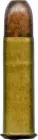
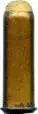
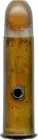

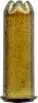
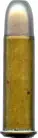
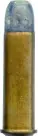
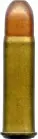
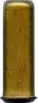
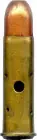


The D with stars is a Devilliers Mock Duel loading with wax ball. E.B.A was by Establissements Bernard Albert, Valence-Sur Rhone. The E.C.P 4-93 specimen is dated April 1893, making it a very early loading. ECP is for Ecole Centrale Pyrotechnie (Central School of Pyrotechnics). BA was for Anciens Ets Marcel Bassot a Harfleur repris par les Fonderies & Laminoires de Paris (Marcel Bassot, taken over by Fonderies & Laminoires de Paris). BS was the code for Atelier de Laminage de l’Ecole Centrale de Pyrotechnie, Bourges. P was the code for S.A. Des Mines et Fonderies de Pontgibaud prior to WW2. R was the code for Tréfileries and Laminoirs du Havre in Rugles. The ELEY .310 was a Cattle Killer case reworked for the Mle. 92. It is the dummy round featured above sixth from the left.


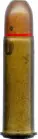
M.G was by Marcel Gaupillat and Co. M.K.C was a contract load for Turkey by SFM. SF was the code for Société Française des Munitions (Gévelot) à Paris, and I was by Société de Métallurgie Franco-Belge à Issy Les Moulineaux. The SF I 2 47 was a very late military headstamp, dating form February 1947, with the Mle. 92 officially retired early in 1948.
