

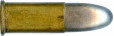
As discussed on previous pages, the discovery of smokeless propellant in 1884 by French chemist Paul Vieille, brought about a revolution in modern firearm design. Revolver designs changed with the adoption of smaller caliber handgun for military and civilian application as designers and manufacturers moved away from big, bulky black powder guns to smaller, more compact designs. That also set the stage for the development of the semi-auto pistol, because there would have been no way that foul burning black powder would reliably function in a semi-auto design; the action would jam after only a few shots. All of us using a semi-auto today for EDC or competition shooting are familiar with the design and workings of semi-autos, but during the late 1880’s and into the early 1890’s, the concept of locked breech mechanisms or blowback actions did not exist and had yet to be invented. Various European inventors were working on the semi-auto concept, and even though the 1892 Lauman design was considered the first, that prestigious title belong to the Salvator-Dormus design with their patent registered in Austria on July 11, 1891, making it the granddaddy of all semi-auto designs.
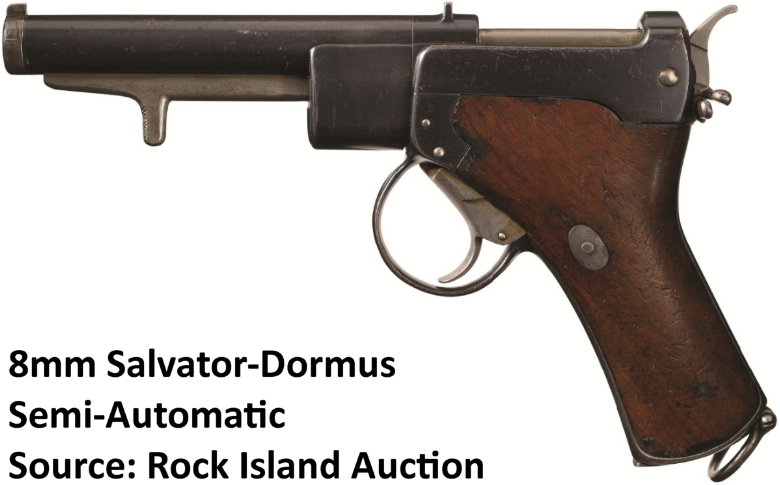
It was a development between Austrian Archduke Karl Salvator and Captain Georg Ritter von Dormus, although Salvator died in 1892, so would never get to see what happened to their design. von Dormus continued with improvements and as far as could be ascertained, a total of 50 were manufactured, of which 30 were entered in the Austrian trials of 1897. As discussed under the 8mm Gasser, the criteria that the trial commission looked at, namely readiness, the ability for follow-up shots and absolute reliability ultimately led to the commission rejecting the Dormus design deeming it overly complicated and the guns reportedly also experienced jamming. With the loss of his royal benefactor, von Dormus abandoned all further work on their design. (Erlmeier, Brandt Ref. 87).
