


The are few names as famous for the finest in gunmaking during the 18th and 19th Century than that of LePage, started by Pierre LePage (1709-1783) and his nephew Jean LePage (1746-1834). Henri Le Page (1792-1854), who was the son of Jean, married the sister of of French gunmaker Louis Perrin, creating the partnership of LePage & Perrin. entrenching the family name in nearly every aspect of gunmaking for well over a century. To follow on from this partnership, Henri’s daughter married French gunmaker Gilles Michel Louis Moutier (1810-1887). The firm of Moutier-LePage was established in 1842 and remained in business under that name until 1868. Gilles Moutier was in his own right capable of producing high quality weapons, as can still be seen in various museums. He was always trying to improve on his designs and one area that was at stage becoming increasingly important was the development of the self-contained metallic cartridge. Work had already stated in America with the Volcanic Repeating Arms Company and Moutier received a French Patent for his version of the designs in 1858. Where the early Volcanic designs focussed on a lever action type pistol, the Moutier design featured a cylinder type six-shot double action revolver.
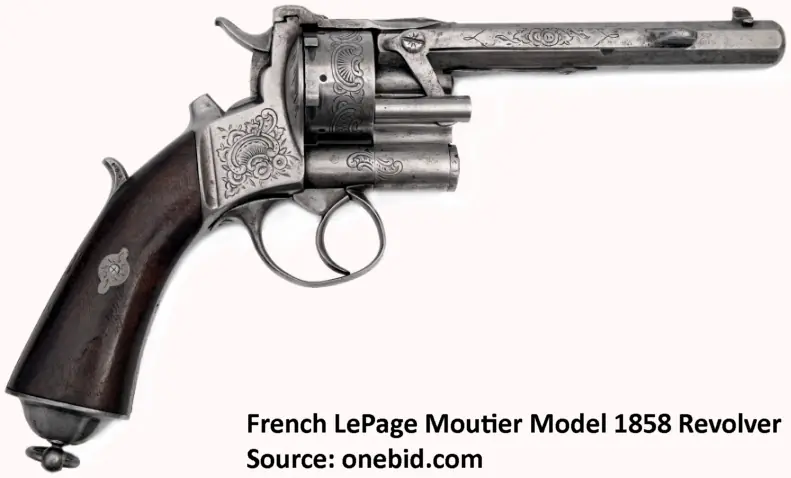
The Moutier design was unique in the sense that when opening, the barrel did not tip upwards, but swivelled to the left, together with the cylinder. The first types used a 9mm version, which achieved limited success, mainly because it was under powered. In 1866, Moutier’s new partner Emile Henri LePage Fauré improved on the original design by reengineering the gun to accept an 11mm metallic cartridge that was more successful and saw use by French Military officers during the Franco-Prussian War of 1870-71. Brandt, p. 319 list this as a 12mm MOUTIER, but that is an error as the actual cartridge is 11mm. (Erlmeier, Brandt Ref. 175C).
