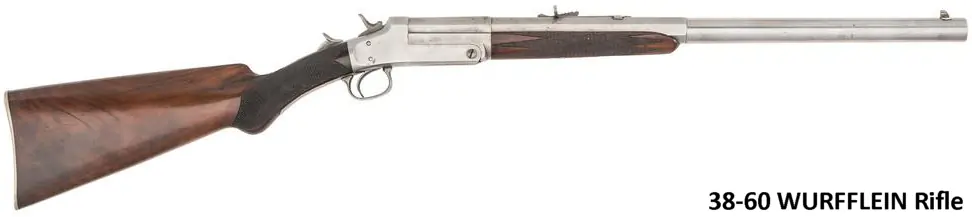

The Wurfflein dynasty in the US started in 1832 with the arrival of Andreas, or Andrew as he was known in America, a German gunsmith immigrant to Pennsylvania where he started his business and by the time his brother John joined him in 1844 the business was already successful. The two brothers were also founding members of the Philadelphia Schuetzen Verrein (Rifle Club) and it presented an opportunity by the members, many of whom were gunmakers to show their wares during competitions with other clubs. It was also the time leading up to the Civil War together with the introduction of the percussion cap replacing the flintlock and the Wurfflein brothers did many of these conversions both for civilian and military contracts as well as producing fine quality firearms, both rifle and handgun. The 1850’s was also the period of industrialisation and the dawn of mass production, especially if one wanted to compete for lucrative government contracts.
Smaller factories, where firearms were individually made by artesans and each part custom made for that rifle would find it hard to compete againts the likes of Springfield Armory and others. Andrew Wurfflein passed away in 1872, but his two surviving sons, Andrew and William Jnr. continued the business and with the lucrative markets for firearms dwindling post Civil War, William expanded to the indoor target shooting market, which grew at a rapid pace in the 1870’s. This was also the period that marked the phasing out of the percussion rifle in favour of the breech loading rifle and William needed to adapt and renew, now competing against the likes of Colt and Sharps. He had employed a designer by the name of Thomas M. Wallis, and he received a patent based on a design by small-time gunmaker, Stevens & Co, for an improved tip-up barrel with ejector. This new venture required a huge amount of capital and his uncle John assisted with a small loan. John Wurfflein at that stage had no living male relative, which made William the only heir in the gun making business and he hoped that his uncle would remember him in his will.
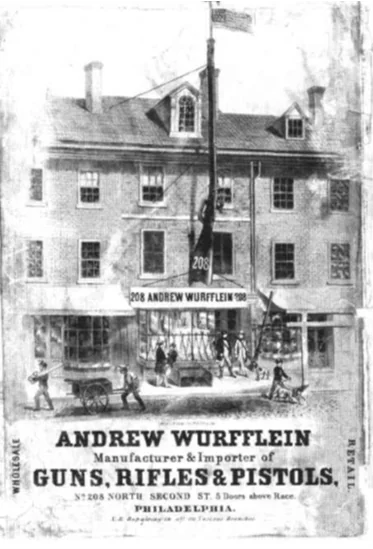
Things did not work out like that for him as John remarried and had two children. When John died in 1884, his entire estate was bequeathed to his children. He did manage to get a loan from John’s widow, but it left him with huge debts. Although the new patent provided uniformity of design, the rifles were still hand made, he relied heavily on catalogue sales and offered his rifles and pistols in cartridges from other manufacturers. The company was however on a slow decline and in 1906 the name was changed to Quaker City Arms and Target Works, but when he could no longer repay the loan from John’ widow, she foreclosed and that was the end of the Wurfflein legacy. William passed away at the age of 67 years on February 22, 1922.
Reference: Willadsen R: 1998. The Wurffleins of Philadelphia: Artisans at the End of an Era. American Society of Arms Collectors, vol 79:14-30 – October 1998.