

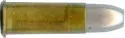
There seems to be a bit of confusion regarding the 8mm Nagant cartridge. Erlmeier, Brand Vol.1 p.131 lists this cartridge (Ref #94) as similar to the 7.5mm Nagant but loaded with a CN bullet with flat tip instead of lead, as the specimen shown above for their Model 1899 Nagant revolver, with cartridges exclusively manufactured by Roth. However, Motz Vol 3, which is the definitive manual on Austrian cartridge development makes no mention of an 8mm Nagant ever being manufactured by Roth. (Erlmeier, Brandt Ref. 94).
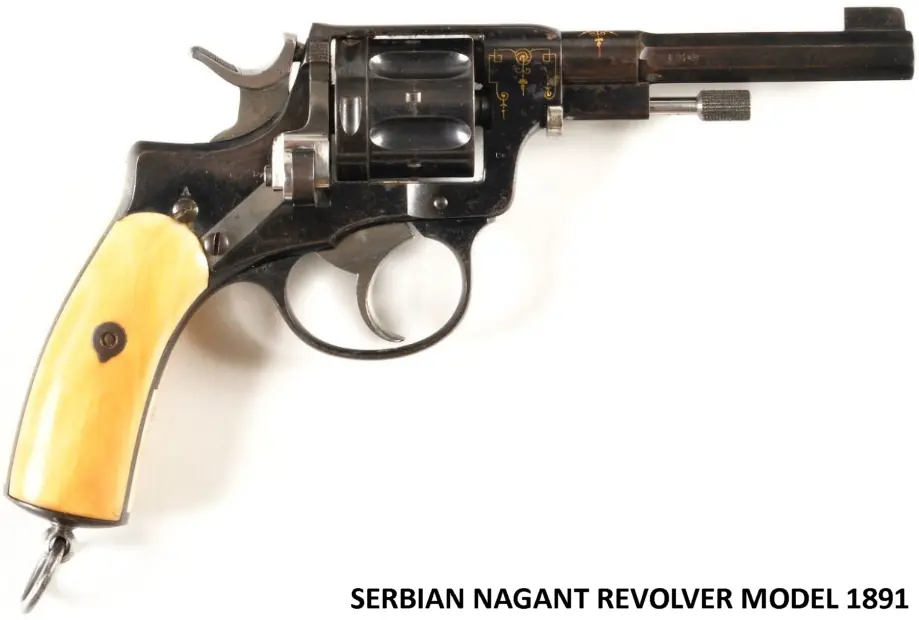
While searching for a picture of the revolver for this article, some of the information does not add up and I found a website that I have consulted previously regarding Belgian firearm manufacturers. There I found an article about the Serbian Nagant revolver written in French. It is embedded in the web page, so I have not been able yet to find the original reference to where it was copied from. From French to English can cause the grammar to become a bit lost in translation, but here is a short summary of the parts relevant to this research.
The Principality of Serbia placed its first official order for Belgian revolvers during 1871, being the 11mm Francotte m/71 revolver. At that stage the decree of February 1863 was still in effect that revolvers were distributed free of charge to all military personnel authorized to receive them.
From 1875 onwards, all officers and NCOs were also issued with sidearms, as were cadets, cavalry, all members of the Guard squadrons as well as field artillery units. Order FN 5166 of June 5, 1876, ordered commissars and paymasters of battalions as well as the High Command to be issued sidearms, with mounted and foot gendarmerie the last be issued on November 30, 1884. The Serbian–Ottoman Wars (1876–1878) as well as the lack of proper care for their sidearms quickly rendered many of the revolvers unusable. Officers were also allowed to use their own private revolvers; some were still using the M1865 Lefaucheux pinfire revolver purchased via the agency of Johann Peterlongo of Innsbruck. During 1881 the firm of Leopold Gasser also set up an agency in Belgrade and their revolvers became popular due to quality of manufacture and resemblance to the original Francotte design. On top of this, Mauser also offered their revolvers even though more expensive than the competition.
This prompted the Serbian military to set up a commission during 1890 in Belgrade tasked with examining various revolvers produced by European and American firms to select a standardised revolver that could be issued to all military branches and government agencies. Two factors had a significant influence on the final decision: firstly, the traditionally good relationship with Belgian manufacturers, as well as their reasonable production costs and the amply demonstrated quality of their products; and secondly, the Swedish influence, amply demonstrated by the choice of the Francotte m/71 revolver in 11mm by both armies as well as the recent choice by the Swedes of the Nagant M1887 revolver, in 7.5mm caliber. After extensive testing at the Banjica shooting range, the Selection Commission finally chose an improved version of the Swedish model on July 8, 1891, contracting with the firm of Emile and Léon Nagant for 12,000 revolvers with ammunition and accessories.
Interesting to note however was Regulation A/TN No. 671 dated February 4, 1895, which covered the manufacture of accessories in Serbia, including holsters as well as ammunition and by 1896 the Kragujevac Military Factory was producing around one million 7.5mm Nagant cartridges per annum, note that there is no mention of an 8mm version. It was during this time that Austrian firm G. Roth began, at the same time, to produce cartridge cases for the Serbian Nagant, listing them in its commercial catalog under case numbers 609 and 2008. Motz Vol. 3 p. 169 and 318 describes case #609 as the 7.5mm Nagant Revolver I, originally from the M1882 Swiss version, manufactured by various European manufacturers (Luxemburg, Norway, Sweden and importantly Serbia). Case #609 however is only listed with the Zinc Cattle killer bullet. Case #2008 is described on p. 217 and 357 as similar to case #609 and the photo on page 217 is the same as the specimen shown above. It was also offered for a limited time only as sales were not sufficient to Serbia.
Politically, Austria took a dim view of the Serbs’ choice of Belgium as their preferred supplier and tried to exert economic pressure on Serbia, leading to a series of customs crises. Unfortunately for them, the Austrian military attaché in Belgrade, Joseph Pomiankowski, could only regretfully inform the Chief of the General Staff, Friedrich Beck, in December 1903 that the Serbian War Ministry had remained loyal to their Nagant revolver. The same went for the Germans, who might have felt especially let down as Mauser had just supplied Serbia with 100,000 rifles of the Mauser-Koka rifles. Mauser even tried to double-cross the Nagant order by offering Serbia the C96 pistol under very favorable terms, but despite this, the Nagant would remain the official sidearm of the Serbian, and later Yugoslav, army until 1924. Even after all that, the Yugoslav military authorities’ once again placed their trust in Belgian manufacturers by choosing the Browning M1910/22.
Sources:
Motz, J & Kohlmann H, (2021). – Austrian Military Cartridges, Vol 3.
